How China's bullet trains are powering
its economy
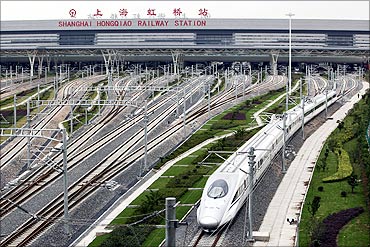
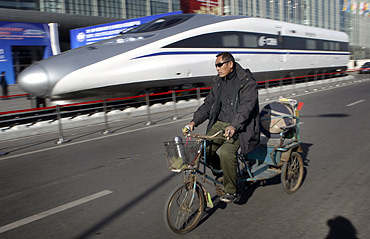
China's high-speed rail project is the biggest transportation infrastructure plan in human history and it is transforming the Chinese landscape.
At a dizzying pace, Beijing has managed to bring to fruition its long-cherished dream of having a modern, super high-speed train system that criss-crosses the nation and is able ferry millions of passengers slashing travel time by over 60 per cent.
In just a few years, the Asian giant has managed to lay down over 5,000 km of new high-speed rail lines. And the plan is to expand it further . . .
Large sections of China's population are becoming more mobile, remote regions of the country are opening up, and Chinese businesses are racing to meet under-served consumer demand.
Image: China's high-speed rail project is the biggest transportation infrastructure plan in human history and it is transforming the Chinese landscape and economy.
Photographs: Reuters

While regional economic differences are not rare in a global economy, China's regional differences are by far the most disparate of any in the world.
The high-speed rail network will tap this geographic-economic imbalance in an unprecedented and aggressive fashion by improving market access, encouraging population mobility, and enhancing logistics efficiency.
Morgan Stanley said in the study that it expects to see lifestyle changes among the population, which in turn will stimulate innovation and creativity and lead to the creation of new businesses in the long-term.
The study said that by 2015, city clusters with travel radii of three hours would start to take shape in China. By 2020, there will be six such city clusters taking shape, overlapping with each other throughout most of China except the northwest and southwest.
These city clusters will cover about 70 per cent of the Chinese population and account for about 75 per cent of China GDP.
The study also said that by 2025 all of these city clusters would be so mature that the regional economic differences in China will narrow to Western economy levels.
According to the investment bank's 'rough estimates', the parts of China that lag behind (central and western China) collectively will be growing at a rate of 15% real GDP in the coming 10 years, compared with their more-developed coastal peers.
Commercial and residential real estate value in the currently lagging cities covered by these city clusters will receive strong support from the launch of new high-speed rail lines.
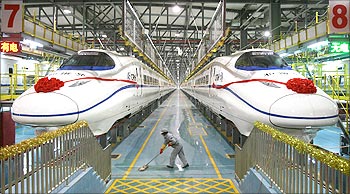
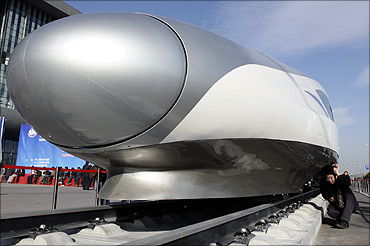
High-speed rail is the key to China's balanced, sustainable double-digit growth. By 2020, four super-city clusters will emerge in China and two existing super-cities will expand as a direct result of the population's increased mobility and the surge in domestic traffic in China.
A more mobile workforce and newly accessible markets will serve to narrow the country's geographic and economic disparities.
The impact is imminent . . . by 2013, 50 per cent of the cities on the planned network will be connected to the high-speed rail grid. The economic impact of this increased connectivity will continue well beyond the immediate gains in key industries, however.
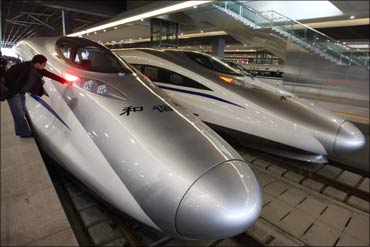
Morgan Stanley analysts, from 12 industries and three continents, have identified the opportunities associated with this mega project.
The global investment bank has created geographic and sector baskets based on its investment analysis, which it believe will capture the secular opportunity in China for the coming 10 years, especially in hotels, restaurants, tourism, car rental, property, and rolling stock. However, aviation and toll roads may not fare as well, claims the Morgan Stanley report.
How high-speed rail is reshaping Chinese economy
China's ever-expanding high-speed rail system is transforming the country, both, economically and socially.
Because China's high-speed rail grid has 10 years more in its construction life cycle, Morgan Stanley is analysing the economic impact of HSR over a 10-year timeframe.
Nevertheless, the investment case is, in fact, imminent: The high-speed rail grid will take shape quickly over the next few years, so investors should take positions today, says the Morgan Stanley report.
According to the national high-speed rail construction plan and our own modelling, more than 50 per cent of cities planned for the high-speed rail grid over the next 10 years will be connected before 2013.
Addressing the concern: Profitability and sustainability
Will the China high-speed rail project be sustainable? This is clearly a valid question to ask. The operating capital required for such a mega project will be substantial.

On the other hand, the operating revenue, based on our ticket price estimate (using the same per-thousand-kilometre price to per-capita GDP ratio on the eastern portion of the national grid), per-thousand kilometre revenue will be around Rmb6.5 billion per year.
This translates into a national operating cash surplus of Rmb2 billion per year, which should be able to cover most, if not all, of the interest expenses.
The funding capabilities of the Chinese government too need to be looked at. The high-speed rail will create substantial new passengers flow, generate new business opportunities, and raise asset prices (such as land and properties).
All these will mean higher fiscal revenue for the local governments. It is estimated that at the national level, every 1,000 km of high-speed rail will create at least Rmb2 billion per year in new fiscal revenue. This is more than enough to close the high-speed rail funding gap.
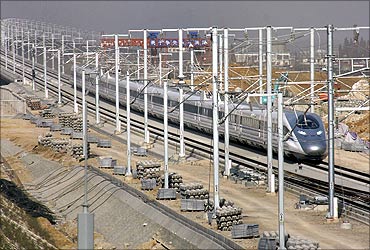
HSR's sector investment implications
As the high-speed rail grid builds out quickly in China, its scale and logistical significance will start to create new business opportunities.
So how big would such business opportunities will be?
Among the sectors where opportunities will arise, according to Morgan Stanley, are:
- Budget hotels;
- Restaurant and catering;
- Tourism (theme parks, resorts, and agencies);
- Consumer staples;
- Retailers and brands;
- Car rental;
- Commercial and residential properties;
- Railway infrastructure; and
- Capital goods and rolling stocks.
- Not surprisingly, the high-speed rail grid is also expected to pose new challenges to existing logistics forms:
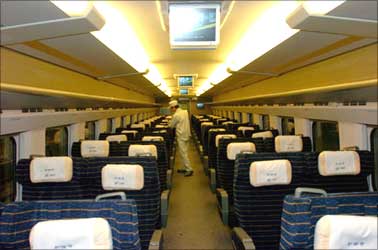
Aviation
The aviation industry in China is likely to feel the heat once the high-speed rail projects are complete. Regional jets will have limited market potential in China and will do well only in those regions where the HSR will not reach, such as the northwest and southwest, assesses Morgan Stanley.
Airlines also will face tough competition on existing regional routes where HSR capacity will increase and divert passenger traffic.
Analysts believe that HSR would be competitive for airlines at a distance of 800-1,500 kilometres and highly competitive at a distance of 800 kilometres.
Because regional jets are usually targeting short- to mid-haul distances between 500 and 600 kilometres, it faces high risk from HSR on overlapping routes.
Toll roads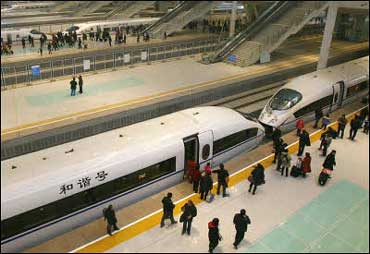
The competition that HSR poses to toll roads will be much smaller than that to airlines due to HSR's expensive ticket price and lack of convenience for short-distance travel.
Analysts expect 1-3 per cent passenger traffic dilution in 2011-13 from toll road to HSR. Furthermore, as HSR can free up cargo capacity in traditional railway system, the potential movement of cargo traffic from toll roads over to traditional railway is likely to be material.
Meanwhile, Morgan Stanley forecast a 10-12 per cent cargo traffic dilution from toll road to traditional railway by 2015.
Other countries' cases turn to support our findings. Japan and the US experiences suggest that the construction of rapid-transit systems led to the urbanisation of local communities, boosted demand of commercial premises, and shored up regional economies.
In addition, passenger railway networks such as the high-speed rail system are expected to have significant positive impact on property values.
On the other hand, history shows the operation of high-speed rail could take substantial market share from conventional operators.
Europe and Japan observed severe blows to their airline traffic from high-speed rail on overlapping routes below 800 km.

അഭിപ്രായങ്ങളൊന്നുമില്ല:
ഒരു അഭിപ്രായം പോസ്റ്റ് ചെയ്യൂ